
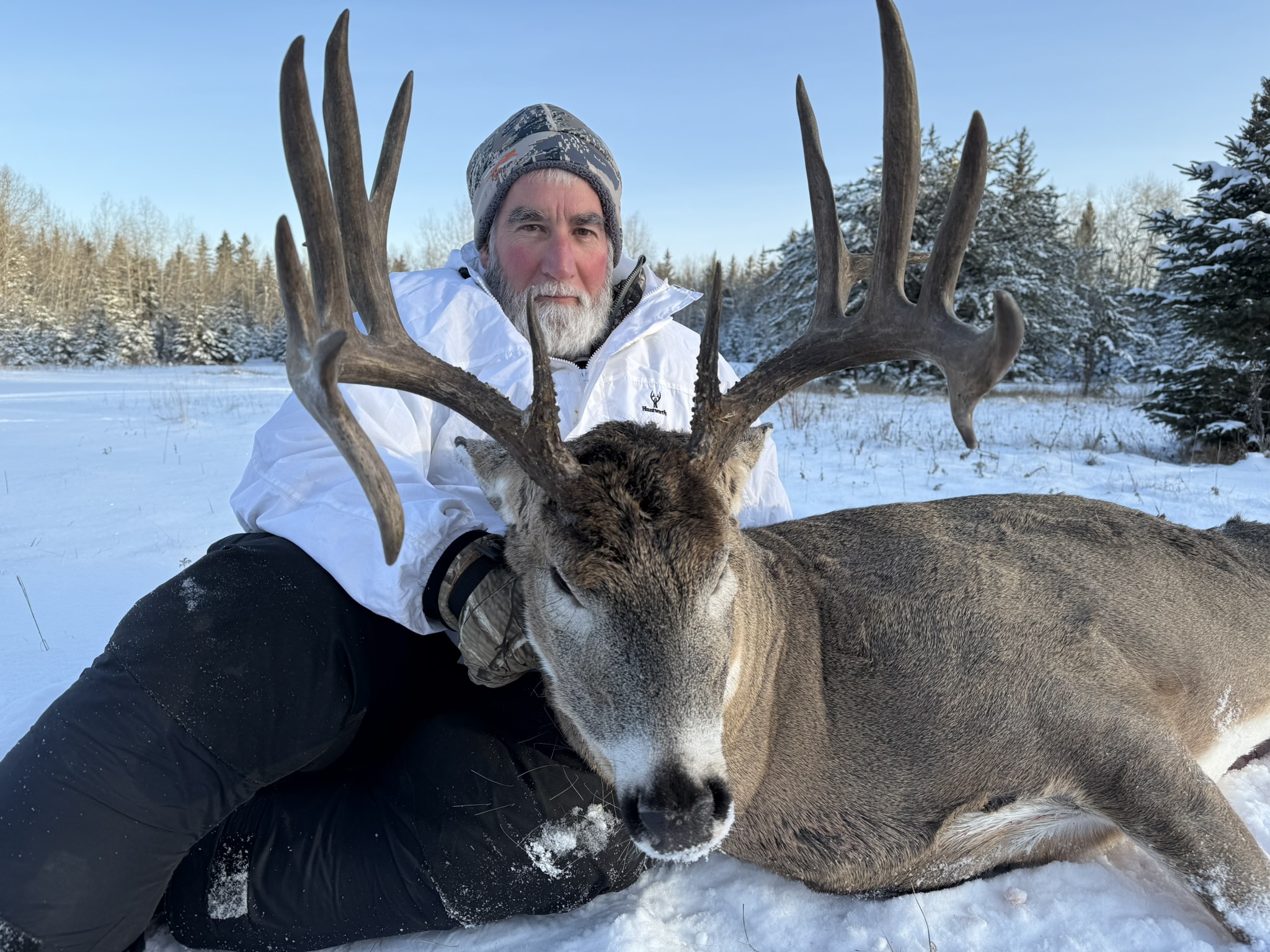
Why Saskatchewan Is Famous for Trophy Whitetail Deer
Big Whitetail Deer at Chaparral Hunting Adventures
Saskatchewan has earned a reputation among serious deer hunters as one of North America’s premier destinations for trophy whitetail deer. Every fall, hunters travel to the province in search of mature bucks with impressive body size, heavy antlers, and the potential to reach the kind of scores that make a Saskatchewan whitetail a true trophy.
But what makes Saskatchewan trophy whitetail deer so impressive?
The answer isn’t simply one factor. Saskatchewan’s reputation comes from a combination of genetics, abundant food, diverse habitat, harsh but productive growing conditions, and the opportunity for bucks to reach a mature old age.
For hunters interested in Saskatchewan whitetail hunting, understanding these factors helps explain why the province consistently attracts hunters looking for a big Saskatchewan whitetail.
Why Is Saskatchewan Famous for Trophy Whitetail Deer?
Saskatchewan is famous for trophy whitetails because many parts of the province provide an excellent combination of food, cover and habitat diversity, while the genetics of the region’s deer can produce impressive body and antler growth.
The Government of Saskatchewan notes that the Dakota subspecies of white-tailed deer, which occupies the Northern Great Plains and Western Canada, is characterized by particularly large body size and antler potential. The province also identifies food supply as an important factor affecting survival, reproduction, body size and antler development.
Saskatchewan’s landscape adds another important ingredient.
Rather than being dominated by one type of habitat, much of the province’s prime whitetail territory consists of a mixture of agricultural fields, wooded areas, river valleys, creek bottoms, brush, wetlands and forest.
For a whitetail, that combination can provide virtually everything it needs:
- High-quality food
- Security and bedding cover
- Thermal protection
- Escape cover
- Water
- Travel corridors
- Seasonal habitat
That diversity is one of the major reasons Saskatchewan has become such a well-known destination for trophy whitetail hunting Saskatchewan.
1. Genetics Matter
Antler size begins with genetics.
A buck’s genetic makeup establishes much of his potential for body size and antler development. Genetics alone, however, do not guarantee a giant set of antlers. A genetically gifted buck still needs adequate nutrition, good habitat and enough time to mature.
Saskatchewan’s whitetails benefit from the characteristics of deer adapted to the Northern Great Plains which produce relatively large body and antler size.
This provides an important foundation for trophy deer.
But genetics are only part of the equation.
A young buck with excellent genetics may not show his full potential until he has reached maturity and experienced several years of good nutrition.
That’s why experienced trophy outfitters don’t focus exclusively on finding young bucks with promising antlers. They look for mature Saskatchewan whitetail deer that have had the opportunity to reach their physical and antler potential.
2. Saskatchewan Has Excellent Whitetail Habitat
One of the biggest advantages Saskatchewan offers whitetails is habitat diversity.
Whitetail deer require more than food. They also need woody cover for security, shelter and browsing, particularly during difficult winter conditions.
Historically, whitetails were strongly associated with forested and brushy environments. In Saskatchewan, agricultural development and changes in vegetation have created a landscape where wooded habitat and productive agricultural land can occur side by side.
Increased woody vegetation, combined with agricultural crops such as cereal grains and alfalfa, has supported large wild whitetail deer populations on the prairies.
That combination is particularly important.
A mature buck may spend one part of the day feeding in agricultural fields and another part of the day bedded deep in cover. Creek bottoms, bush, shelterbelts and wooded draws can provide the security he needs between feeding periods.
For hunters, these transitions between habitat types can become important travel routes.
3. Agriculture Provides High-Quality Food
Food is one of the biggest contributors to deer growth.
Saskatchewan’s agricultural landscape provides whitetails with access to a variety of nutritious food sources, depending on the region and season.
Cereal grains, alfalfa, forage crops and other agricultural vegetation can supplement the natural browse and forage found in surrounding habitat.
Food supply affects survival, reproduction, body size and Boone & Crockett antler scores. Adequate year-round nutrition allows bucks to grow antlers closer to their genetic potential.
This is particularly important during the summer growing period, when bucks are developing their antlers.
A mature buck needs substantial nutrition to grow a large rack. When quality food is available across the landscape, deer can enter fall in excellent physical condition.
That doesn’t mean every Saskatchewan buck becomes a trophy. It means the environment can provide the nutritional foundation required for exceptional deer.
4. The Boreal Forest and Agricultural Landscape Create a Unique Combination
One of Saskatchewan’s most interesting advantages for whitetails is the transition between different ecosystems.
In many areas, agricultural land eventually gives way to aspen forest, bush, wetlands and boreal habitat.
This creates a highly varied landscape.
For whitetails, the combination can mean:
Agricultural land = food
Bush and forest = security
Creeks and river bottoms = travel and cover
Wetlands and lowlands = additional habitat diversity
Edges and transitions = movement corridors
The result is a landscape with abundant opportunities for deer to find food and remain relatively secure.
The boreal forest itself is extensive across northern Saskatchewan, while the agricultural regions to the south provide a different combination of food-producing land and natural cover. Saskatchewan’s landscapes therefore contain a broad range of habitat conditions rather than a single uniform deer environment.
For hunters pursuing mature bucks, those habitat transitions can be especially interesting because older deer often become experts at using cover and terrain to their advantage.
5. Harsh Winters Can Help Shape Big Deer
Saskatchewan is not an easy environment for a whitetail. Winter can be severe.
Deep snow, extreme cold and limited winter forage can place significant demands on deer. The Dakota whitetail’s relatively large body and thick winter coat are adaptations that help it survive the conditions found across the Northern Great Plains. That harsh environment creates a fascinating contrast.
Saskatchewan whitetails need to survive some challenging conditions, but when spring and summer arrive, the landscape can provide a tremendous amount of high-quality forage.
The annual cycle is therefore important:
Winter: survival and energy conservation
Spring: recovery and new plant growth
Summer: rapid antler development and body growth
Fall: peak body condition and the rut
The bucks that successfully navigate this cycle year after year are the ones that can eventually reach maturity.
6. Age Is a Major Part of Trophy Potential
If you’re looking for a truly exceptional whitetail, age matters. A young buck simply has not had the same amount of time to develop as an older buck.
Antler development changes as a buck matures. While there is considerable individual variation, mature bucks generally have greater potential for heavier beams, greater mass, longer tines and wider antler configurations than younger deer.
This is one reason experienced Saskatchewan deer hunting operations place such importance on mature bucks.
The objective isn’t simply to find any buck with antlers. It is to find a mature buck that has had enough time to develop his potential. And that’s where selective hunting can make a significant difference.
7. Mature Bucks Behave Differently
Age doesn’t only affect antler size. It can also affect behavior.
Older bucks have survived multiple hunting seasons. They have experienced pressure, learned their surroundings and developed established patterns.
A mature buck may spend daylight hours in thick cover and move into feeding areas under the cover of darkness. He may use terrain, wind and vegetation to remain difficult to detect.
That’s part of what makes trophy whitetail hunting Saskatchewan so challenging.
Finding a mature buck is one thing. Getting close enough to harvest him is another. The challenge of hunting an old Saskatchewan whitetail is part of what makes the experience so rewarding.
8. What Makes a 150-Inch Whitetail Special?
Hunters often use antler score as one way to describe the size of a whitetail. A 150 inch whitetail Saskatchewan buck represents a substantial trophy and is the type of deer that attracts serious attention from hunters pursuing mature animals. However, gross score is only one measurement of a deer.
Two bucks with similar scores can look dramatically different. One might have impressive width, another might carry exceptional mass, while another could have long tines and a distinctive frame. For many hunters, the character of the antlers is just as memorable as the final number on a score sheet.
You know I like, what I look for in a whitetail is a typical. I like the typicals. I don’t like the gnarly kind of mangled up racks. I like a typical. Coming here I wanted to add a a true 10-point frame that obviously had, you know, scored a little higher than my last whitetail. I look for the symmetry and the mass. If you have those two things I think that’s what continues your journey in whitetail hunting.
- Josh Groan – see more…
At Chaparral Hunting Adventures, the focus is on mature Saskatchewan whitetails, with a 150-inch minimum helping establish the standard for the deer being pursued.
That means the goal isn’t simply to hunt Saskatchewan whitetails. The goal is to pursue the kind of mature trophy that serious whitetail hunters travel to Saskatchewan to find.
9. Saskatchewan’s Landscape Rewards Hunters Who Understand Deer
Trophy whitetail hunting is rarely about simply sitting in the woods and waiting. Successful outfitters need to understand how deer use their environment.
A mature buck may have several preferred bedding areas, feeding locations and travel routes. Those patterns can change according to weather, hunting pressure, food availability and the rut.
Understanding the relationship between:
- Food
- Bedding cover
- Water
- Security cover
- Terrain
- Wind
- Hunting pressure
- Seasonal movement
can make a major difference. This is especially true when hunting mature bucks.
An older Saskatchewan whitetail has had years to learn its environment. Hunting that buck requires patience and a willingness to hunt the landscape rather than simply a particular location.
10. Saskatchewan Offers More Than Big Antlers
For many hunters, the appeal of Saskatchewan goes beyond the possibility of harvesting a trophy. It is the entire experience.
The wide-open agricultural landscape. The northern forests. The cold mornings. The changing fall colors. The anticipation of seeing a mature buck step out of cover.
And then there is the deer itself.
A mature Saskatchewan whitetail is an impressive animal. Large-bodied, heavily antlered and perfectly adapted to the environment, a mature buck represents years of survival.
That’s what makes a Saskatchewan trophy whitetail deer meaningful. It isn’t just the inches of antler. It is the age, habitat, genetics and conditions that came together to produce the animal.
Why Choose Chaparral for Saskatchewan Whitetail Hunting?
At Chaparral Hunting Adventures, our approach to whitetail hunting is centered around pursuing mature Saskatchewan bucks rather than simply maximizing the number of deer opportunities.
Our 150-inch minimum reflects that philosophy.
The goal is to provide hunters with an opportunity to pursue a truly mature Saskatchewan whitetail in an environment capable of producing exceptional deer.
For hunters who have dreamed of a big Saskatchewan whitetail, Saskatchewan provides an ideal setting for the pursuit.
The combination of genetics, agricultural food sources, forest and brush cover, diverse habitat and mature deer creates the foundation for some of Canada’s most exciting whitetail hunting.
Frequently Asked Questions About Saskatchewan Trophy Whitetail Deer
Why is Saskatchewan famous for trophy whitetails?
Saskatchewan combines favorable whitetail genetics with diverse habitat, agricultural food sources, extensive cover and the potential for bucks to reach mature ages. The province’s Dakota white-tailed deer sub-species are also recognized for relatively large body and antler size.
How big do Saskatchewan whitetail bucks get?
Saskatchewan produces mature whitetail bucks with substantial body size and antler growth. Individual antler size varies considerably according to genetics, nutrition, age and habitat conditions.
What makes a Saskatchewan whitetail a trophy?
A trophy whitetail can be evaluated by several characteristics, including age, body size, antler mass, spread, tine length and overall antler configuration. Many hunters also use standardized antler scoring systems to quantify antler size.
What is a 150-inch whitetail?
A 150-inch whitetail is a buck whose antlers measure approximately 150 inches under the applicable scoring system. It represents a substantial trophy-class deer, although the appearance and characteristics of individual bucks can vary considerably even at similar scores.
Is Saskatchewan good for whitetail hunting?
Saskatchewan offers extensive whitetail habitat and a combination of agricultural and natural landscapes that can support mature deer. Hunting opportunities and regulations vary by region and season, so hunters should always contact their outfitter before departing on their hunting trip.
Why are mature bucks harder to hunt?
Older bucks have survived previous hunting seasons and can become highly experienced at avoiding hunters. They may use thick cover, travel primarily during low-light periods and alter their movement in response to hunting pressure.
What makes Chaparral’s whitetail hunting different?
Chaparral Hunting Adventures focuses on pursuing mature Saskatchewan whitetails and maintains a 150-inch minimum for the bucks being targeted. This approach is designed for hunters specifically interested in pursuing a mature trophy rather than simply harvesting any whitetail.
The Saskatchewan Trophy Whitetail Advantage
The reputation of Saskatchewan trophy whitetail deer isn’t based on one secret ingredient. It comes from the combination.
Large-bodied Northern Great Plains genetics. Agricultural food sources. Forest and brush cover. Diverse habitat. Seasonal nutrition. Harsh winters. And, perhaps most importantly, the opportunity for individual bucks to survive long enough to reach maturity.
Put those factors together and it becomes easier to understand why hunters from around the world continue to look to Saskatchewan when planning a serious whitetail hunt.
For hunters searching for a big Saskatchewan whitetail, the province offers the habitat and environment that can produce exceptional mature bucks.
And for hunters who want to take that pursuit a step further, Chaparral Hunting Adventures offers an opportunity to focus specifically on mature trophy-class Saskatchewan whitetails, with a 150-inch minimum setting the standard for the hunt.
If your goal is to hunt a mature Saskatchewan whitetail, the right habitat is only the beginning. The real challenge is finding—and successfully hunting—the buck that has survived long enough to become a trophy.